

When Christians feel threatened, the danger can begin to fill their entire view. Revelation first directs their attention to the One who rules over it.
John does not begin by asking the churches to identify a modern political leader or calculate the end of the world. He introduces the Lord who loves them, has redeemed them, and speaks to them. Read the whole passage before working through the sections below. Notice what John says directly, what the vision portrays, and which symbols Jesus explains.
1. Grace before the conflict
Read Revelation 1:4–6 in the NKJV ↗
The letter is addressed to seven churches in Asia. These are congregations with names, responsibilities, weaknesses, and reasons to be afraid. The greeting offers grace and peace from the eternal God, the seven Spirits before His throne, and Jesus Christ. The description of the seven Spirits is understood here as symbolic language for the fullness of the Holy Spirit, rather than seven separate gods.
Jesus is identified as the faithful witness, the firstborn from the dead, and the ruler over earthly kings. His testimony can be trusted, His resurrection establishes His supremacy over death, and His authority exceeds the power of human rulers. These descriptions prepare the reader for the rest of the book.
John also connects Christ’s love with His saving action: Jesus washed believers from their sins in His blood and made them kings and priests to God. Their standing before God does not depend on an emperor’s approval. Before the churches hear about the enemy’s threats, they are reminded of what Christ has already done for them.
2. The ruler above earthly rulers
Read Revelation 1:7–8 in the NKJV ↗
The announcement of Christ’s coming lifts the churches’ attention beyond the apparent permanence of earthly power. The One who was rejected will be openly revealed. Human resistance will not have the final word.
Verse 8 presents the Lord as the Alpha and the Omega and the Almighty. Alpha and omega are the first and last letters of the Greek alphabet. The language declares God’s comprehensive authority and eternal existence. Governments can act as though nothing stands above them; Revelation begins by showing that their claim is false.
That does not mean believers can predict the date of Christ’s return or ignore their present duties. It means that faithfulness is never pointless simply because evil appears powerful. We must read the visions that follow in the light of the Lord’s authority, rather than allowing frightening imagery to make us forget Him.

3. A companion in suffering
Read Revelation 1:9–11 in the NKJV ↗
John introduces himself as the churches’ brother and companion in tribulation, the kingdom, and the patience of Jesus Christ. He is not observing their suffering from a comfortable distance. He shares the need for endurance.
John says that he was on Patmos because of the word of God and the testimony of Jesus Christ. He receives a command to write what he sees and send it to seven named churches. His circumstances have restricted his location, but they have not prevented Christ from speaking through him.
Notice the connection between kingdom and endurance. Belonging to Christ does not mean that a Christian will escape every hardship. John belongs to the kingdom while suffering. When we experience opposition, we should not automatically conclude that Christ has abandoned us or that obedience has failed.
4. The glory of the living Christ
Read Revelation 1:12–16 in the NKJV ↗ · Compare Daniel 7:9–14 ↗
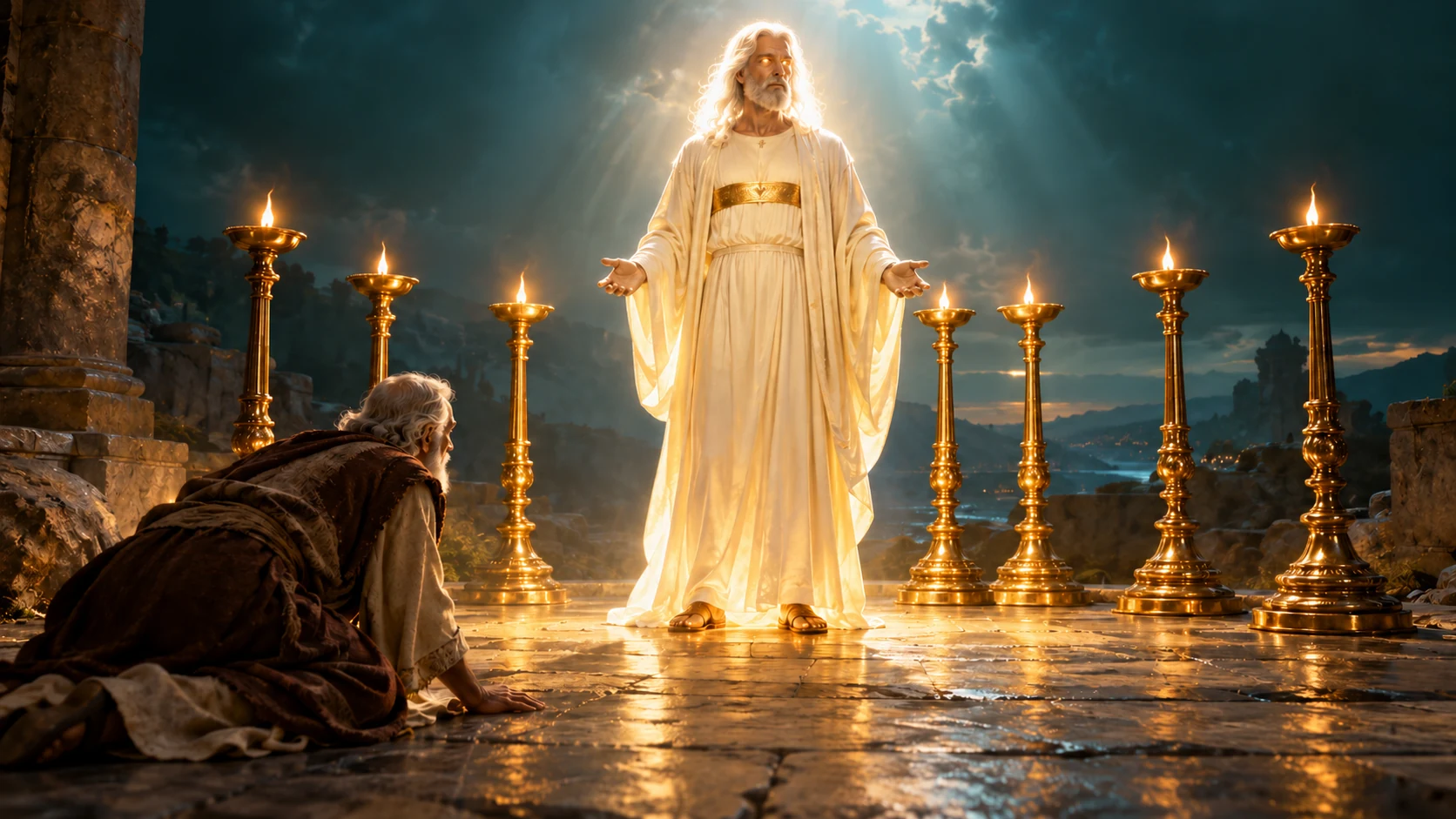
John turns and sees seven golden lampstands and a figure like the Son of Man standing among them. The description is a vision of majesty, not instructions for painting a literal portrait. The robe and golden band, white hair, fiery eyes, bronze-like feet, mighty voice, stars, sword, and radiant face direct attention to Christ’s glory and authority.
Daniel’s visions help us recognize the biblical background of this language. The imagery should lead us toward reverence and confidence in the Lord, rather than an attempt to identify modern machinery hidden in His appearance. In Revelation itself, Christ’s searching eyes and the sword from His mouth are connected with His knowledge and judgment as He addresses the churches.
We should avoid assigning an elaborate meaning to every visual detail as though John had supplied an exhaustive key. The main impression is unmistakable: the Jesus who suffered and died is living, glorious, and powerful. The churches must listen to Him.
5. Jesus among His churches
Read Revelation 1:19–20 in the NKJV ↗ · Look ahead to Revelation 2:1–5 ↗
Jesus explains that the seven lampstands represent the seven churches, and the seven stars represent their angels. The passage gives us these identifications; we do not need to replace them with modern countries or institutions. The precise identity of the angels has been understood differently, so we should distinguish that discussion from the explanation the text explicitly supplies.
Christ’s position among the lampstands is especially significant. He is present among the congregations that receive His message. Their struggles are not taking place outside His knowledge. The following letters show that He knows their service, suffering, compromise, and need for repentance.
His presence brings both comfort and accountability. A congregation cannot assume that being called a church means everything it does is approved. Nor should a faithful congregation assume that being small, opposed, or overlooked makes it forgotten. The question is whether we are listening to the Lord who knows us.
6. Authority over death
Read Revelation 1:17–18 in the NKJV ↗
John falls at Christ’s feet as though dead. Jesus places His right hand on him and reassures him.
“Do not be afraid; I am the First and the Last. I am He who lives, and was dead, and behold, I am alive forevermore. Amen. And I have the keys of Hades and of Death.”
Revelation 1:17–18, NKJV
The reassurance rests on who Jesus is. He has truly died, yet He lives forever. The keys picture His authority over death and Hades. Those who can threaten a believer’s earthly life do not possess the final authority over that believer’s future.
This does not remove the pain of persecution or grief. It gives Christians a reason to remain faithful through them. Our confidence rests in the living Christ, rather than a guarantee of comfortable circumstances. Before we study what the churches must overcome, we must remember the Lord who has already overcome death.
Ask where fear, habit, or the desire for approval is making it difficult to obey Christ. Then identify one faithful response you can make this week. His presence should strengthen our obedience as well as our comfort.
Questions for reflection
- Which descriptions of Jesus in verses 5–6 would give courage to Christians living under hostile rulers?
- What does John’s description of himself teach us about suffering and belonging to Christ’s kingdom?
- Which symbols does Jesus explicitly explain in verse 20? Why should we begin with those explanations?
- How does Christ’s presence among the churches bring both encouragement and responsibility?
- How should Christ’s authority over death affect our response to pressure to compromise?