
An illustrated Bible study
What Are You Building Your Life On?
Hearing Jesus and Building on the Rock
In this study
A house can look secure while resting on a weak foundation. The walls may be straight and the roof may appear sound, yet what supports the building matters more than what someone notices from the road.
Jesus uses that picture at the end of the Sermon on the Mount. Two people build houses. Both houses face a storm. One stands, and the other falls.
The lesson is about our response to Jesus. We can hear His words, recognize their importance, and still fail to build our lives on them.
A Serious Ending to the Sermon
Read Matthew 7:21–29.
Jesus has been teaching His listeners how to live before God. His sermon reaches into the heart, our relationships, our speech, our priorities, and the way we treat other people.
Near its conclusion, He warns that calling Him Lord is not a substitute for doing the Father’s will. Then He describes the two builders.
We should read this parable with that warning in mind. Jesus is not offering a general lesson about being determined or believing in ourselves. He is calling us to respond to His teaching with obedience.
The crowds are astonished by His authority. The question for every listener is whether that astonishment will become a life shaped by what He says.
Both Builders Hear
Read Matthew 7:24, 26.
There is an important similarity between the two people in the parable: both hear Jesus’ words.
The foolish builder does not represent only someone who has never encountered His teaching. Jesus describes a person who hears it but does not put it into practice.
That makes the warning especially relevant to people who regularly read Scripture, attend worship, or listen to Bible lessons. Familiarity can help us learn, but familiarity alone is not obedience.
Knowing where a passage is found, remembering its words, or agreeing that it is true does not settle whether we are following it.
The difference between the builders appears in what they do with what they hear.
What Building on the Rock Means
Read Matthew 7:24–25.
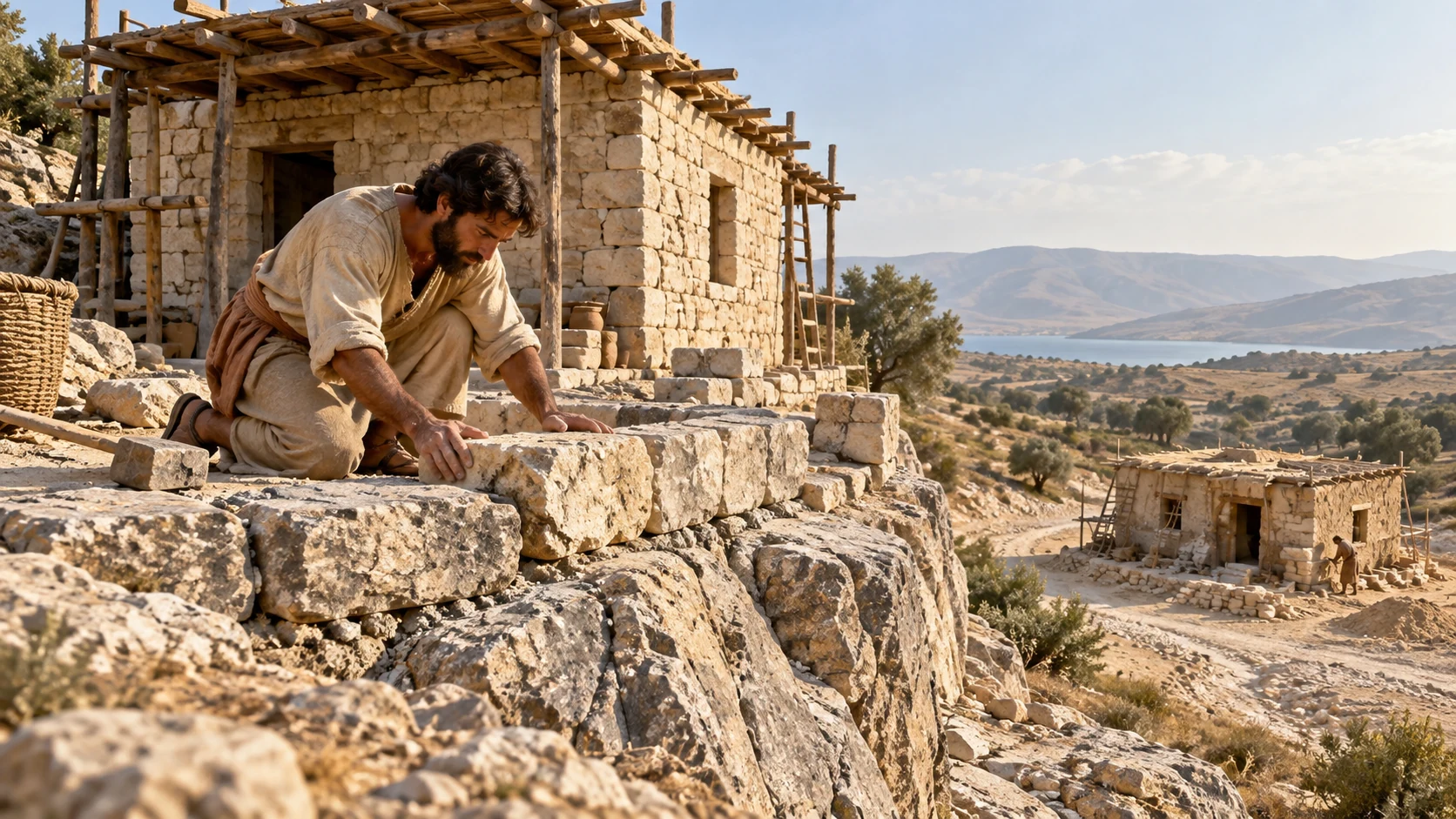
Jesus compares the person who hears and does His words to a wise man who builds on rock.
The foundation is not personal confidence, family tradition, or the approval of a religious crowd. The comparison directs us to a life that responds to Jesus’ authority by practicing His teaching.
Consider the instruction He has already given. He teaches reconciliation in Matthew 5:23–24, love for enemies in Matthew 5:43–48, and seeking God’s kingdom first in Matthew 6:33.
Building on His words reaches into those ordinary decisions. Will I take responsibility for a broken relationship? Will I pray for someone who treats me badly? Will I allow God’s priorities to govern my choices?
These are opportunities to move from appreciating the sermon to living by it. The builder’s wisdom becomes visible in the foundation he chooses, just as a disciple’s trust becomes visible in obedience.

Both Houses Face the Storm
Read Matthew 7:25, 27.
Rain falls, floods come, and winds beat against both houses. The wise builder is not given a different weather forecast.
We should not turn this passage into a promise that obedient people will avoid illness, grief, financial difficulty, or opposition. In Jesus’ illustration, the difference is the foundation and the outcome, not an exemption from the storm.
As an application, pressure can expose what we have relied on. Approval from others may disappear. Comfort may change. Our own understanding may prove inadequate.
Following Jesus gives us direction when circumstances are difficult: we still have a Lord to trust and teaching to follow. This does not make pain imaginary or every decision easy. It calls us to remain faithful rather than abandon His words when obedience becomes costly.

The Warning Is Bigger Than Difficult Days
Read Matthew 7:21–27.
It is helpful to apply the parable to life’s trials, but we should not overlook its surrounding warning about entering the kingdom and standing before the Lord.
Jesus describes a great collapse. Hearing Him without obeying Him is not a small weakness that can safely be ignored.
A comfortable season does not prove that our foundation is sound. Neither does a sincere claim that we belong to Him settle whether we are doing His will.
We need to examine our lives by His teaching while we have the opportunity to respond. The point is not to compare how religious we look beside someone else. It is to ask whether Jesus’ words have authority over us.
Put One Teaching Into Practice
Read Matthew 7:24–27 again.
Having finished a Bible study, it is easy to begin looking for the next one. Learning more is valuable, but this passage asks us to do something with what we have already heard.
Choose one instruction from the Sermon on the Mount that you have been avoiding or postponing. Read it in context. Identify the response it calls for, and take a concrete step toward obedience.
That might involve seeking reconciliation, correcting dishonest speech, reconsidering a misplaced priority, or showing love where you have been withholding it.
These steps do not purchase God’s favor. They are ways of responding faithfully to the Lord whose words we claim to trust.
The question Jesus leaves us with is personal: am I merely hearing Him, or am I building my life on what He says?
Questions for Reflection
- Why does it matter that both builders hear Jesus’ words?
- What can make knowing a teaching feel like the same thing as obeying it?
- Which instruction in the Sermon on the Mount most challenges your present choices?
- How does the surrounding warning in Matthew 7:21–23 deepen the meaning of the parable?
- What specific step could you take to put something Jesus teaches into practice?
Images are AI-generated illustrations of Jesus’ parable.
← All written Bible lessons